Innis & Gunn founder Dougal Sharp has called on the government to stop pushing the pub to the brink of extinction and take measures to reverse the industry’s decline.
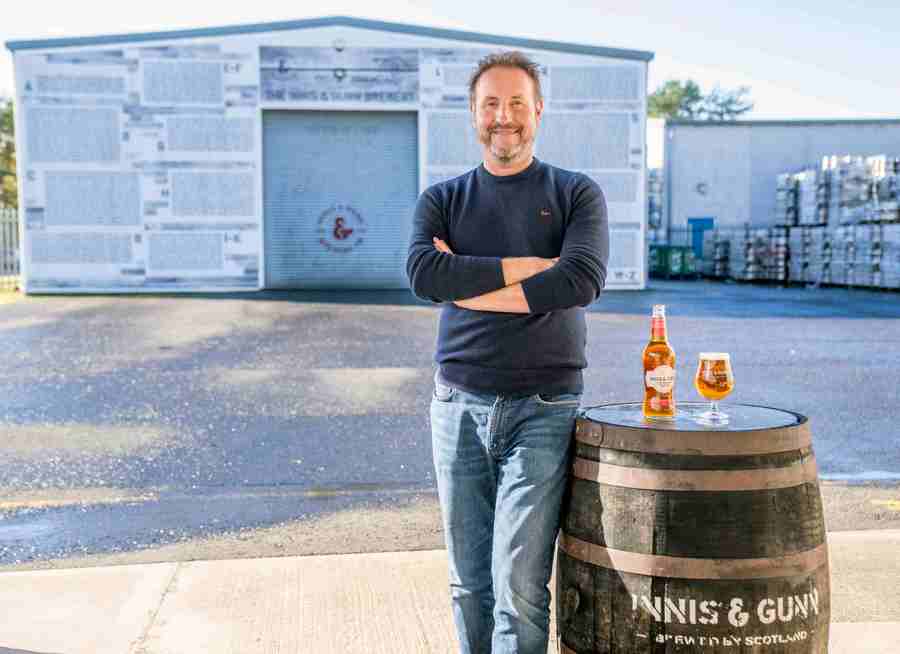
Dougal Sharp at the Innis & Gunn brewery
According to government statistics, one pub per day closed in England and Wales during 2025. Figures in Scotland for 2024 show there were 56 closures, which is unlikely to have slowed last year.
Sharp, who started his brewing career at Caledonian Brewery 40 years ago and who founded Innis & Gunn in 2003, said that he had never known a tougher time for the industry. The brewer currently operates three taprooms in Edinburgh and Glasgow, which employ more than 100 people.
“In my four decades in brewing and pubs, I’ve never known it to be tougher,” he said. “Hundreds of pubs are being forced to close every year across the UK, taking thousands of jobs with them.
“While this is often dismissed as a consequence of ‘market forces’, the reality is far more damaging. Each closure represents lost connections, lost social interaction, and the erosion of community life.”
Sharp argues that many pubs are being forced to the brink by rising costs, much of which is being driven by government policy. Industry analysis suggests that around one-third of the cost of a pint is accounted for by taxes alone.
“One of the biggest drivers of this decline is cost. The cost of going out has become absurd, and a lot of that is to do with the costs being imposed on hospitality businesses. Soon enough, the £10 pint will be a fixture of pubs across the country.
“Hospitality in the UK pays full 20% VAT, while many comparable countries back their hospitality industries with a far lower rate on food. Duties on alcohol are among the highest in the world. Then, there’s business rates, which have become a game of political bingo.
» Enjoying Beer Today? Become a Patreon supporter from £1.50 a month
“On top of that, our energy prices are the most expensive in the developed world, and some of the regulation brought in for pubs in recent years has been well-intentioned, but a lot is pure bureaucratic theatre.
“Of course we want to pay staff fairly, but the rising minimum wage, combined with employer National Insurance contributions, adds up at a time when many businesses are already stretched. All these things together turn into reduced hours, fewer staff, less training, less investment, and another ‘To Let’ sign.”
While measures have recently been announced by the UK and Scottish governments to provide support on business relief — such as the 15% non-domestic rates relief outlined in the Scottish Budget for 2026-27 — Sharp says these are nowhere near enough. Along with other voices in the industry, he is calling for the government to take urgent action to support the industry and reverse its decline.
“The recent measures are too little and, for many pubs, too late. Pubs shouldn’t be treated like a convenient cash machine, but like what they are: a national institution.
“So, here’s the challenge to Westminster and the devolved governments. Cut on-trade duty by 50%. Cut VAT for hospitality to 8%. Cut energy costs 30% by removing net zero charges. And reduce business rates by making the amount payable an affordable percentage of actual turnover.
“The outcome we’re aiming for is simple, normal, and frankly not revolutionary: getting pints below £4, making pub food affordable, and making pubs full, thriving places again. Save the pub, and you save something bigger than a pint. Kill it, and don’t be surprised when the country feels colder, lonelier, and ultimately loses an important part of its identity.”